
Outsourcing staff is more than a buzzword; it’s a financial strategy that can significantly shape the operations of your business. This is because most small, large, and medium-scale business organisations are restructuring their workforce, financial management, and goal orientation to enhance efficiency because of a dynamic economy that is always changing.
The article analyses the financial benefit of staff outsourcing that includes definitions, facts, and key takeaway points.
What is Staff Outsourcing?
Outsourcing of staff refers to the engagement of the services of external employees or third-party service providers to undertake in-house responsibilities.
There are various models:
- Project outsourcing – Work involving tasks like project completion, undertaken by third-party professionals
- Remote staffing – individuals who are long-term team members of a company but work remotely through a third-party vendor that
- Business Process Outsourcing (BPO) – Outsourced processes may include human resources, payroll, technology, or customer services
Outsourcing assists companies in making their fixed worker expenses variable expenses.
In terms of financial planning, it becomes easier for firms to manage their workforce, as it becomes an activity done on a modular scale. This means that they can increase or decrease their workforce without worrying about costs associated with restructurings or recruiting, which enhances their financial flexibility.
Why Businesses Outsource: Financial Perspective
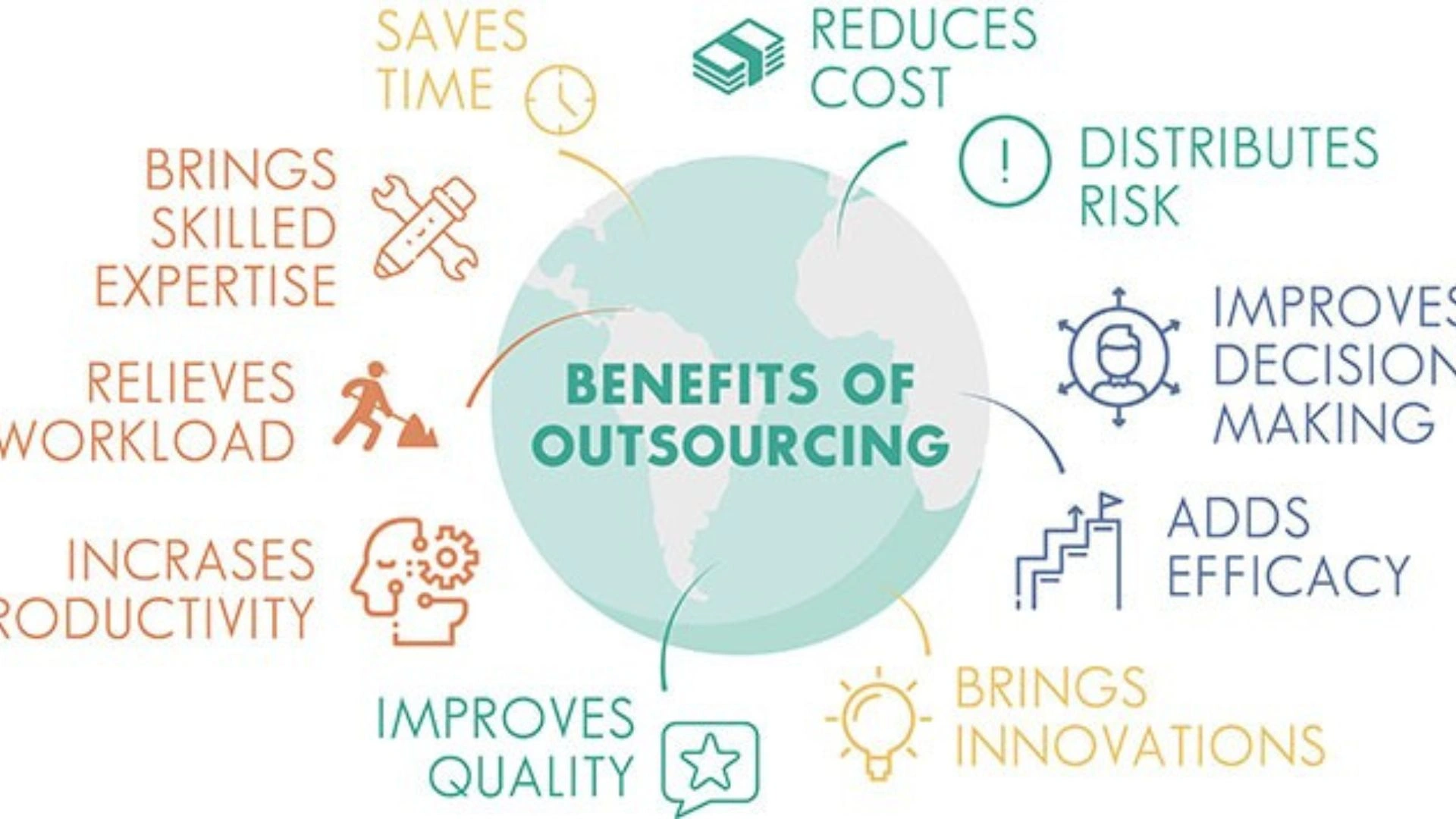
Cost savings have been listed as a major factor that propels organisations to outsource services.
- 57% of firms outsource primarily for cost-cutting purposes.
- A saving of 30-60% has been reported by various organisations by contracting important activities such as IT, finance, or customer service.
- The cost of labour may be cut by a maximum of 70% through outsourcing.
These statistics prove why outsourcing is one of the most successful financial strategies for today’s companies.
Core Financial Benefits of Staff Outsourcing
Let’s list the major financial benefits provided by outsourcing.
1. Major Cost Cuts
By outsourcing, an organisation eliminates recruitment, salaries, and other indirect costs
Direct Savings include:
- Lower wages in offshore/nearshore locations (30% to 70% below U.S./Europe levels).
- No Payroll Taxes, Benefits, or Retirement Costs for Contracted Employees
- Reduce recruiting and training costs
Indirect savings are:
- Lower costs for office facilities, equipment, and utilities
- Lower spending on training and technology improvement
For instance, firms that offshore HR tasks enjoy an average savings of ~27% compared to in-house HR management.
2. Improved Budget Predictability
Outsourcing involves transferring fixed costs of employment to variable or result-based fees.
As a result, companies pay for services rather than salaries, benefits, and infrastructure.
This will have two financial advantages:
- Improving cash flow management
- Improved forecast and scalability
Variable costs correlate with demand – if business decreases, so does spending.
3. Faster Return on Investment (ROI)
ROI is more about efficiency and quality enhancements rather than simply cutting costs.
- For example, certain companies claim that outsourcing yields returns that are 231% greater than in-house management.
- Some people find significant effects within 12 months.
ROI can increase when outsourcing partners involve specialised equipment not present in-house.
4. Access to Specialised Expertise (Without Premium Salaries)
It allows the company to tap into highly qualified people without having to pay market rates for them, since they will be outsourced.
The benefits are:
- Expertise with complex subjects such as IT, Accounting, and Compliance
- Direct access to Best Practices and current technology
- Minimised the chance of high-cost internal mistakes or internal delays
This approach not only helps in saving money; it can even generate more revenue through faster and better projects.
5. Emphasis on Core Revenue Activities
When routine work is outsourced, certain work can be done by:
- Product development
- Sales & Business Growth
- Customer Experience
Through resource reallocation, innovation, and profit can be generated, rather than simply looking for ways to reduce costs.
Step-by-Step: How outsourcing improves financial performance
Here are the steps to follow to calculate the financial effect of outsourcing:
1. Uncover Non-Core Activities
Make a list of the tasks that are repetitive, time-consuming, and/or not a core competence.
2. Estimate In-House Costs
Consider such areas as wages, benefits, training, technology, and the workplace
3. Obtain Outsourcing Quotes
Ask for proposals from interested parties.
4. Compare Total Costs
Consider costs other than hourly fees – the costs of employing people.
5. Calculate Financial Impact
To factor in efficiency gains, revenue acceleration, and risk mitigation.
6. Explain Metrics
Depending on the provider, KPIs could include cost per task, turnaround time, and output quality.
7. Monitor and Adjust
The performance needs to be reviewed quarterly to ensure that the savings
The advantage of this approach is that it not only enables companies to outsource, but it also helps them to do so in an
Common functions companies outsource
Certain industry sectors that ensure lucrative results when outsourced include:
- Human Resources – payroll, benefits, compliance
- Finance & Accounting – bookkeeping, billing, financial reporting
- IT-Services – Helpdesk, Cybersecurity, Software-Support
- Customer Support – phone, email, chat service
- Marketing Operations – content creation, campaign management
Every such function can be made a variable cost centre rather than an overhead team.
Risks to consider and mitigation
However, outsourcing is not without risks, but most of these risks are easily overcome with appropriate planning.
Common concerns:
- Communication problems
- Quality control
- Data security and compliance
Mitigation strategies:
- Provide clear SLAs (Service Level Agreements)
- Regular performance reviews
- Good contractual provisions and confidentiality safeguards
A managed outsourcing arrangement eliminates risk to finance and maximises benefits.
Conclusion
Employee outsourcing is not just about reducing expenses; it’s a financial plan that brings efficiency, adaptability, and growth. By being aware of the benefits it brings, including how to measure it, business owners can make informed decisions to improve their financial standing today, tomorrow, or in the coming years.
FAQs
1. What savings can result from business outsourcing?
Cost savings have been estimated at 15% to 30% for businesses, while for specialised functions such as IT, it could be 70%.
2. Can Outsourcing Enhance ROI?
Yes. Some companies have shown over 200% return on investment by outsourcing.
3. Is outsourcing only beneficial to large corporations?
No. Small to medium-sized companies greatly benefited, particularly in the realms of HR, IT, and customer service, where specialisation is expensive.
4. Can quality be affected by outsourcing?
Quality also relies on the choice, selection, or management of partners. Goals, expectations, communication, and KPIs are important in sustaining good quality.
Also Read:
7 Common Misconceptions About Staff Outsourcing