
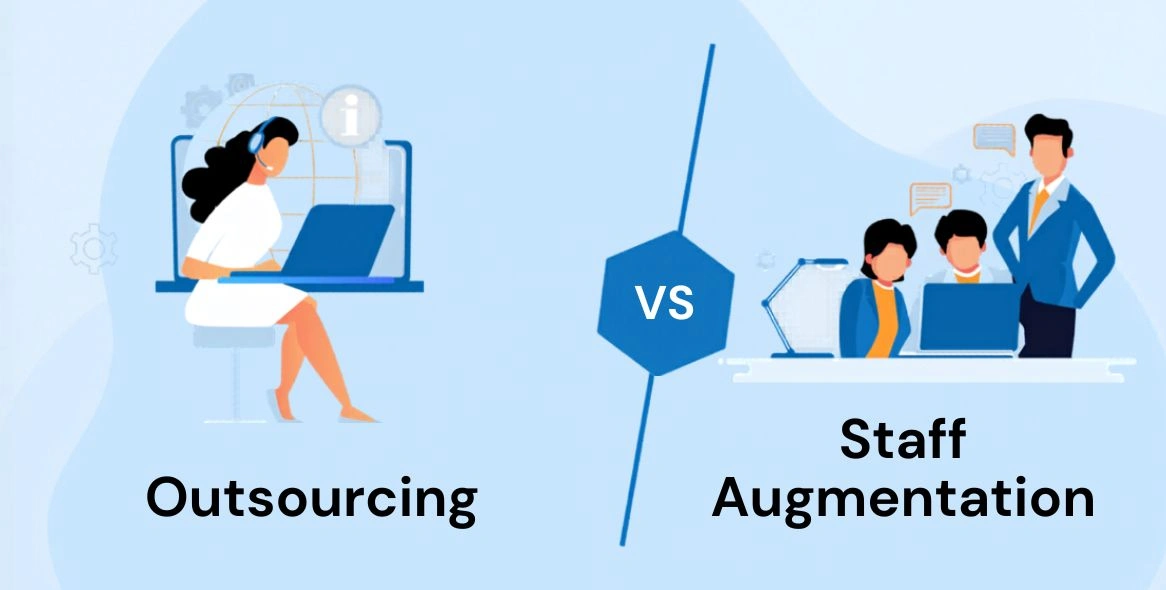
Businesses looking to scale often choose between staff augmentation and outsourcing. While both models help access external talent, they differ in management, cost, and scalability.
Understanding these differences will help you choose the right solution for your business growth.
What is Staff Augmentation?
Staff augmentation is a flexible hiring model where businesses temporarily add skilled professionals to their in-house team to meet short-term project needs.
The company manages:
- Daily operations
- Task allocation
- Team performance
What is Outsourcing?
Outsourcing is a business model where companies delegate entire processes or functions to an external service provider who manages operations end-to-end.
The outsourcing partner handles:
- Recruitment
- Workforce management
- Compliance
- Performance delivery
Staff Augmentation vs Outsourcing (Quick Comparison)
| Staff Augmentation | Outsourcing |
| You manage the team | Vendor manages operations |
| Short-term hiring model | Long-term strategic solution |
| Higher internal workload | Reduced management effort |
| Limited scalability | Highly scalable |
| Requires internal HR support | End-to-end service |
Key Differences Explained
1. Management Control
- Staff Augmentation: Full control but higher responsibility
- Outsourcing: Less control but minimal operational burden
If you lack internal HR infrastructure, outsourcing is more efficient.
2. Cost Efficiency
- Staff Augmentation: Costs include salaries + internal management
- Outsourcing: Bundled pricing with optimized cost structure
Outsourcing often reduces hidden costs like compliance and administration.
3. Scalability
- Staff Augmentation: Limited by internal capacity
- Outsourcing: Easily scalable across projects and locations
Outsourcing is Ideal for businesses expanding in GCC markets.
4. Compliance & Risk
- Staff Augmentation: You handle legal compliance
- Outsourcing: Vendor ensures compliance
This is critical in regions with complex labor laws.
5. Speed of Deployment
- Staff Augmentation: Moderate hiring speed
- Outsourcing: Faster deployment with ready resources
When Should You Choose Staff Augmentation?
Staff augmentation works best when:
- You have a strong internal team
- You need temporary skilled professionals
- You want full control over operations
Challenges of staff augmentation
However, drawbacks of staff augmentation are also there:
Communication and Collaboration
Usually, external staff operate from home settings. That’s why it is very important for the organisation to set up proper communication mediums and excellent workflows.
Security and Data Access
Each company should be certain that external employees adhere to data security policies without any negligence.
Knowledge Transfer
If suitable documentation and communication of knowledge are not done correctly, temporary staff may leave once the projects are finished.
These dangers could be reduced by selecting reliable vendors and systematically introducing them to the company’s operations.
When Should You Choose Outsourcing?
Outsourcing is the better choice when:
- You want to reduce operational workload
- You need end-to-end workforce solutions
- You require compliance and payroll management
- You want to scale quickly without hiring complexities
Why Outsourcing is the Preferred Choice for GCC Businesses
In regions like the Middle East, outsourcing provides:
- Compliance with local labor laws
- Faster workforce deployment
- Reduced administrative burden
- Cost-effective scaling
This makes outsourcing a more practical and reliable solution compared to staff augmentation.
How 6-Pence Helps You Scale with Outsourcing
At 6-Pence, we provide end-to-end outsourcing and recruitment solutions designed for business growth.
Our Services Include:
We handle everything from hiring to compliance, so you can focus on your core business.
Conclusion
Both models have their advantages, but:
Staff augmentation is ideal for short-term support.
Outsourcing is ideal for long-term growth and efficiency
For businesses looking to scale without operational complexity, outsourcing is the smarter choice.
FAQ
1. What is the main difference between staff augmentation and outsourcing?
The main difference is that staff augmentation adds temporary professionals to your internal team, while outsourcing transfers complete business functions to an external provider who manages operations end-to-end.
2. Which is more cost-effective: staff augmentation or outsourcing?
Outsourcing is generally more cost-effective because it includes workforce management, compliance, and administrative tasks, reducing hidden costs compared to staff augmentation.
3. Is outsourcing better than staff augmentation for long-term projects?
Yes, outsourcing is better suited for long-term projects as it provides scalable, end-to-end solutions with reduced operational burden and consistent performance management.
4. When should a business choose staff augmentation over outsourcing?
A business should choose staff augmentation when it needs short-term skilled resources and has the internal capacity to manage teams and operations effectively.
Also Read: