
Many businesses have been reluctant to consider staff outsourcing, which is attributed to misconceptions about the costs, quality, or control involved in such outsourcing. The truth, however, is that today, a majority of companies have already implemented outsourcing.
Most common misconceptions about staff outsourcing in today’s world:
Myth 1: Outsourcing is only about cost-cutting
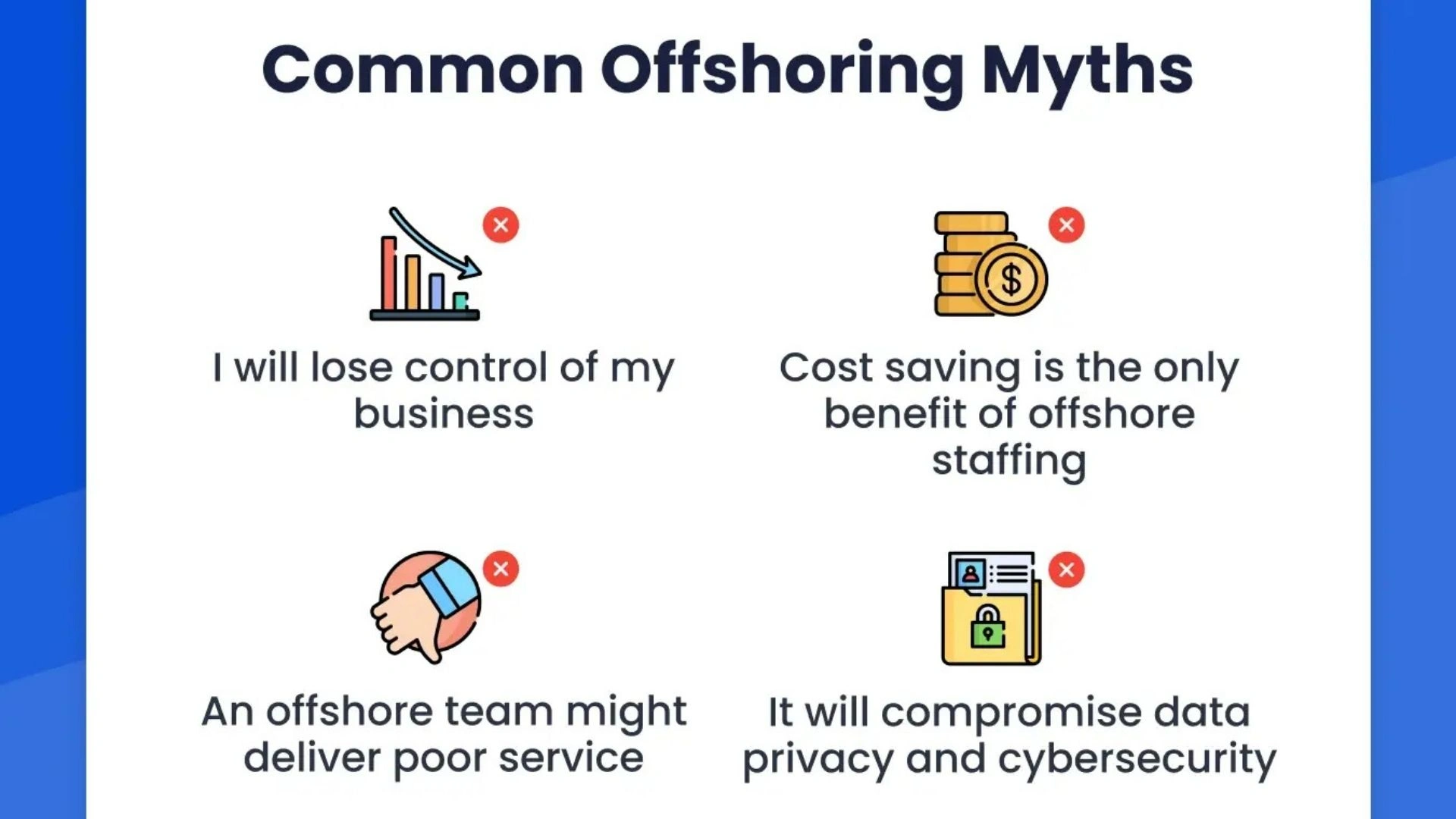
One fallacy is that corporations are outsourcing workers solely for the purpose of cutting expenses, regardless of quality concerns that could affect the bottom line. While it is a consideration, recent data have presented a more balanced view.
- Approximately 70% of senior managers listed cost savings as a fundamental reason for outsourcing.
- Although almost 59% view outsourcing as providing access to stronger skills and abilities.
- According to an Information Services Group (ISG) study, the average cost savings is 15%, with better quality performance of 11% that can be achieved by outsourcing.
This highlights that staff outsourcing is done to control costs as well as improve service levels, and certainly not with the intention of “doing the same work cheaper at any cost.”
Myth 2: Staff Outsourcing lowers quality
Many leaders fear that outsourced staff will produce low-quality work or be less dedicated than internal teams. Yet, in properly managed outsourcing arrangements, the quality trends generally tell the opposite story.
- A survey cited by Deloitte points out that while 59% of the businesses outsource to cut costs, 57% do it in order to focus on the core business and enhance service quality.
- It invests heavily in training, technology, and performance monitoring, since it depends on its reputation and meeting of strict service-level agreements.
With clear KPIs, processes documented, and reviews frequently, the outsourcing staff will be able to perform equally or even better than internal teams.
Myth 3: Outsourcing means losing control
Another myth surrounding outsourcing is that once the staff is outsourced, the manager loses control. It is a fact that staff outsourcing will, in actuality, result in the client maintaining control.
- In staff outsourcing arrangements, the service provider deals with the personnel, payroll, and compliance aspects, while the client has control over the work and performance aspects.
- Providers often allow clients to be involved in processes to select candidates and agree on KPIs.
While it distances management, it, in fact, divorces people management functions from the management of the business.
Myth 4: It’s only for big corporates
Outsourcing personnel support was considered a tactic for large multinational corporations with large budgets and global reach. But new information reveals that small and mid-sized companies are some of the quickest to adapt and implement.
- According to recent statistics available for 2023, it has been estimated that approximately 66% of US companies have adopted outsourcing for at least one of their departments, such as IT, marketing, or customer support functions.
- According to a Clutch study, 83% of small businesses planned to continue or even expand their spending or outsourcing engagement with the services they considered essential to accessing specialised skills and technologies.
In the case of smaller businesses, outsourcing the workforce brings the benefit of enterprise-level capabilities without the overhead of a large in-house talent pool.
Myth 5: Outsourcing causes massive job losses
Outsourcing has also been widely criticised for directly leading to unemployment in local markets. In reality, the outsourcing issue is more complex and depends on how businesses choose to utilise the workers they hire through outsourcing.
- Industry analyses indicate that the outsourcing process has developed into a mechanism for rebalancing, whereby low-order activities or supporting tasks are outsourced, and high-order jobs are developed or maintained in-house.
- Given the fact that more than half a company considers outsourcing at least one business process, many say the practice helps them remain competitive and grow. The reason is that outsourcing helps them ensure the protection of domestic jobs.
Outsourcing of staff change tends to redefine roles rather than substitute them, particularly whenorganisationss invest their savings in innovation and local development.
Myth 6: Outsourced teams lack expertise
Decision-makers in some cases perceive that the skill sets of employees who are contracted out are lower or that they rely upon outdated software compared to what they do in-house. The current trend is that this perception is often opposite to the result.
- In the tech world, more than 94% of businesses worldwide use outsourcing in some form, with the tech industry making up more than 55% of the market share in the outsourcing market. This is an indicator of the confidence the tech world has in the tech skills that come with outsourcing.
- Many staffing and outsourcing companies have specialised in a given industry, having expertise and candidate pools not easily attainable for an organisation on its own.
For tasks involving specialist skills, teaming up with a contracting specialist outsourcing partner would prove the quickest route to attaining the desired skill sets.
Myth 7: Outsourcing is only for long-term, large projects
Outsourcing is only feasible for large projects spanning multiple years. In reality, staff outsourcing is very flexible in terms of scale and time.
- Market research reveals that firms use the process of outsourcing for short-term specialised activities as well as certain departmental functions based on their requirements.
- A survey cited by Clutch shows that small businesses tend to outsource discrete services like marketing, IT, and design, and they do so on either a project or part-time basis, rather than outsourcing entire functions.
This ensures flexibility for companies, which enables outsourcing to be used in a low-risk test scenario before moving into more significant engagements.
In Conclusion
As a conclusion to this discussion, it should be noted that various concerns raised when it comes to staff outsourcing are generally founded upon myths that do not apply to current outsourcing practices.
From being merely a cost-reduction strategy to becoming an ability-driven approach that enables businesses to achieve enhanced abilities in regard to product or service quality, performance robustness, and time to market, outsourcing has become more of an art that creates departures than risks for businesses when it comes to recruiting support staff.
FAQs
1. Does staff outsourcing only apply to larger businesses?
No. Smaller and medium-sized companies are relying on personnel outsourcing in order to take advantage of expert knowledge and cut personnel expenses, without having to maintain large in-house teams.
2. Can companies lose control by outsourcing their workforce?
No. The provider is responsible for matters concerning employment and HR. The client remains in charge of other tasks and performance.
3. Is Staff Outsourcing a long-term commitment?
No, it is not. Many companies begin with short-term or project-based offshoring and then build on it if it proves successful.
4. Does Staff Outsourcing always result in reduced quality?
No. Because the KPIs are clear and good governance is in place, the remote staff can equal or better the performance of the in-house staff.
Also Read:
Difference Between Staff Outsourcing and Manpower Supply