
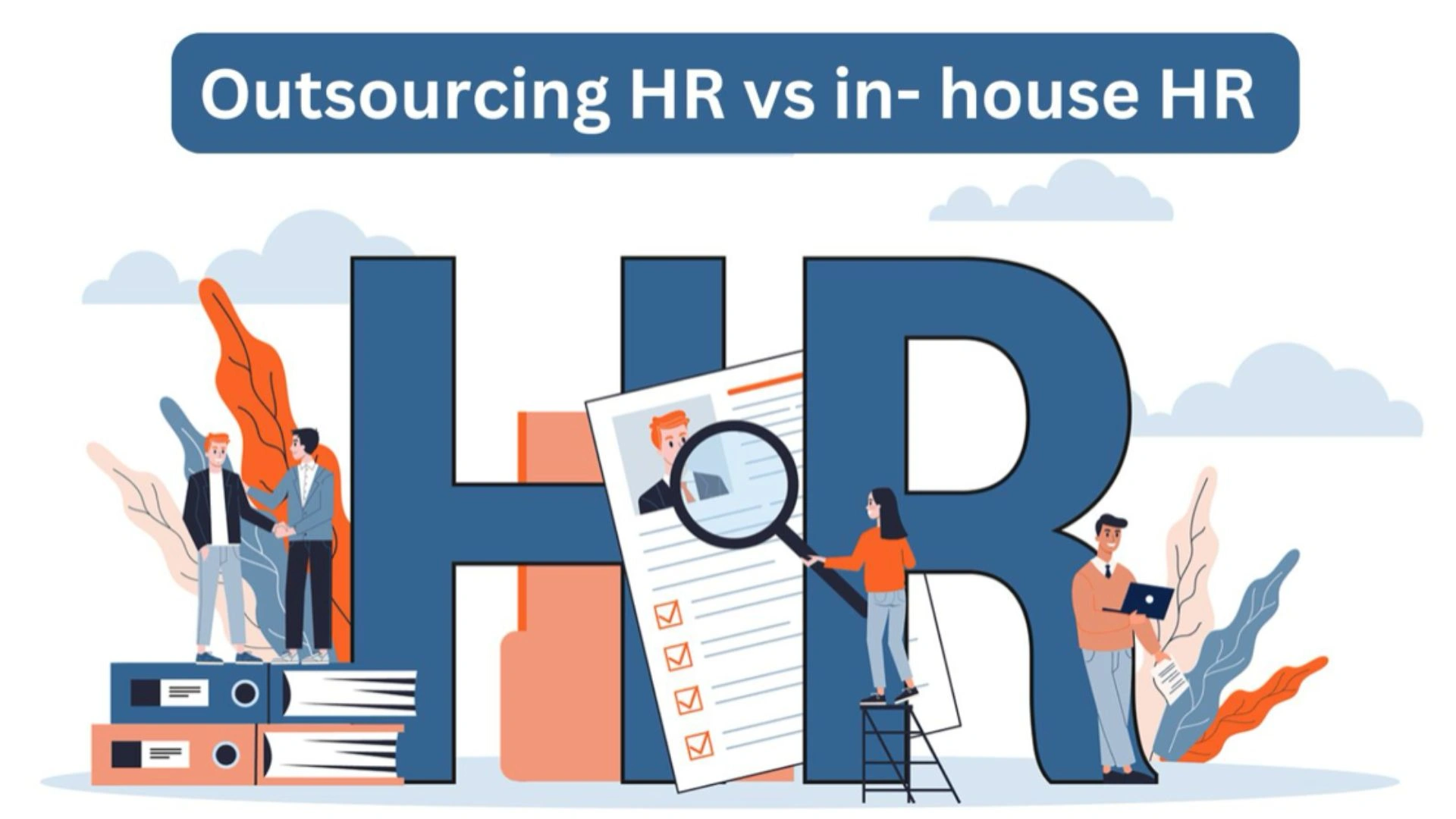
Human Resources (HR) is a pivotal department that shapes various aspects of the company, such as employee experience, compliance, talent strategy, and business performance in general. A company’s HR structure can be based on two main models:
- In-house HR: A self-sufficient team handling HR functions internally
- Outsourced HR: Engaging external professionals for some or all HR tasks
This article covers the contrasts, merits, issues, and actual data of both methods, providing you with a decision-making tool on which model suits your business best.
What is in-house HR?
Going In-house HR basically means that the company itself deals with all the HR work, hiring, onboarding, compliance, employee relations, and performance management. These HR people are your employees, on your payroll, and are part of your organisational structure.
Key Benefits of In-House HR
- Better understanding of company culture and values
- Spot, face, and plan a response to employee issues
- Employee engagement becomes a matter of ownership
- More well-informed strategic people decisions
- Leadership collaboration becomes easier and deeper
- Freedom in terms of HR data and policies
Difficulties of In-House HR
- High fixed costs (salaries, benefits, software, training)
- There is only a limited supply of specialised expertise for highly complex areas of HR
- Administrative burden and resource drain
- Difficulty in keeping up to date with changes in laws and regulations
- Scaling means the hiring and training of additional staff
In-house HR is normally a good pick for large businesses that have a steady demand for HR and a budget that can fit full teams.
What is outsourced HR?
Outsourced HR is essentially hiring external HR service providers who perform human resource functions for your organization, either completely or partially, for example, payroll, compliance, benefits administration, recruitment, or performance management.
Key Benefits of Outsourced HR
- Cost savings: A lot of businesses reduce HR administrative expenses through outsourcing, even by 25%- 30%.
- Time savings: The time spent on administrative HR tasks can be cut by a maximum of 35% through outsourcing.
- Experts at your disposal: Providers are compliance, recruitment, compensation, analytics, and strategic planning specialists.
- Modern technology: Outsourced HR often means that you get the latest HR platforms, dashboards, and automation tools.
- Flexibility: You can also vary the size of services according to the business needs without making internal hiring.
Potential Drawbacks of Outsourced HR
- Less direct control over daily HR interactions
- Cultural alignment can be more challenging
- Careful coordination may be necessary to address sensitive HR issues
- Outsourced teams may have a limited understanding of the internal context and values
Nevertheless, outsourced HR represents a great advantage for small and mid-sized businesses, startups, or companies experiencing rapid growth.
Real statistics: In-house vs outsourced HR
Here are several verified research results reflecting the practice of HR models by corporations:
Employee Experience & Satisfaction
- Over 80% of employees say they are more satisfied with HR services after outsourcing because of quicker response times.
- 85% of companies that use HR outsourcing experience an increase of 10% in employee engagement scores.
- More than 60% of the employees say that their HR problems got solved quickly when the HR department got outsourced.
These numbers are a clear indication that human resource outsourcing can be a significant factor in employee engagement and start to have a better reaction from the HR department
Cost and Efficiency Impact
- A company that decides to outsource HR functions can see a cut of up to 30% in its overall administrative costs.
- Outsourcing HR has the potential to bring down the time used on administrative HR tasks by 35%.
What these numbers show is that outsourcing can be an effective way of getting operational efficiencies, in particular, for those organizations that want to dedicate their internal resources to strategy work rather than the execution of routine tasks.
Comparison between in-house and outsourced HR
| Charatcteristics | In-house HR | Outsourced HR |
| Cost | Higher fixed costs for salaries, benefits, and software | Lower variable costs; typically 25-30% savings |
| Expertise | May be limited to internal team skills | Access to specialists and broader HR knowledge |
| Scalability | Requires recruiting and training | Easily scalable based on business needs |
| Cultural alignment | Strong cultural integration | Requires effort to align with company values |
| Tech and tools | Must invest internally | Often included via provider platforms |
| Compliance | Dependent on internal capability | Outsources keep up with evolving regulations |
When in-house works best
Having HR in-house works best if your company:
- faces complicated cultural integration issues
- Put internal governance and fast HR response at the top of the priority list
- Has a large headcount and continuous HR needs
- Needs to frequently brainstorm talent development strategies internally
This approach offers customisation and full authority over decisions associated with HR.
When outsourced HR is advantageous
Outsourced HR is the right decision for companies that:
- Are interested in cutting overhead costs and administrative work
- Experience changes in their HR workload or have seasonally fluctuating hires
- Lacks the HR expertise internally for a particular business area, and doesn’t want/are not able to hire a full-time specialist
- Want to extend HR support rapidly without increasing the number of employees
Very often, outsourcing at the same time offers companies a greater degree of cost, effectiveness, and flexibility, especially for startups, SMBs, or companies in fast growth.
A hybrid approach – best of both worlds
Most companies use a hybrid HR model; they retain strategic HR functions in-house (culture, leadership development, employee relations) but outsource the more administrative or technical functions like payroll, compliance, benefits administration, or recruitment.
By doing so, they efficiently manage costs and maintain internal control while securing the expertise of specialists.
FAQs
1. Is outsourcing HR always cheaper than having an in-house HR department?
Not necessarily, some studies have even shown that administrative costs can be decreased by as much as 30% through outsourcing.
2. Can outsourced HR take care of all HR functions?
Certainly, depending on the nature of the agreement, providers can handle everything from payroll, recruitment, compliance, to employee benefits.
3. Do employees like HR support being outsourced?
Many employees have reported higher satisfaction and faster resolution of their problems when HR was outsourced.
4. What does a hybrid HR model mean?
It is a combination of providing in-house and outsourcing of HR functions, the intention of which is to enjoy a balance of control, customization, cost, and expertise.
Also Read:
Best Manpower Supply Company in Bahrain for Construction
Top 8 Questions to Ask Before Hiring a Staffing Agency