
From small to large and across various sectors, businesses utilize employee outsourcing as a strategy to cut costs and acquire specialized skills that will make their business more flexible in the marketplace. It was a niche strategy, but it is a key tool in doing business, with a projected 867 billion USD worth of outsourcing service markets by 2027.
What is Staff Outsourcing?
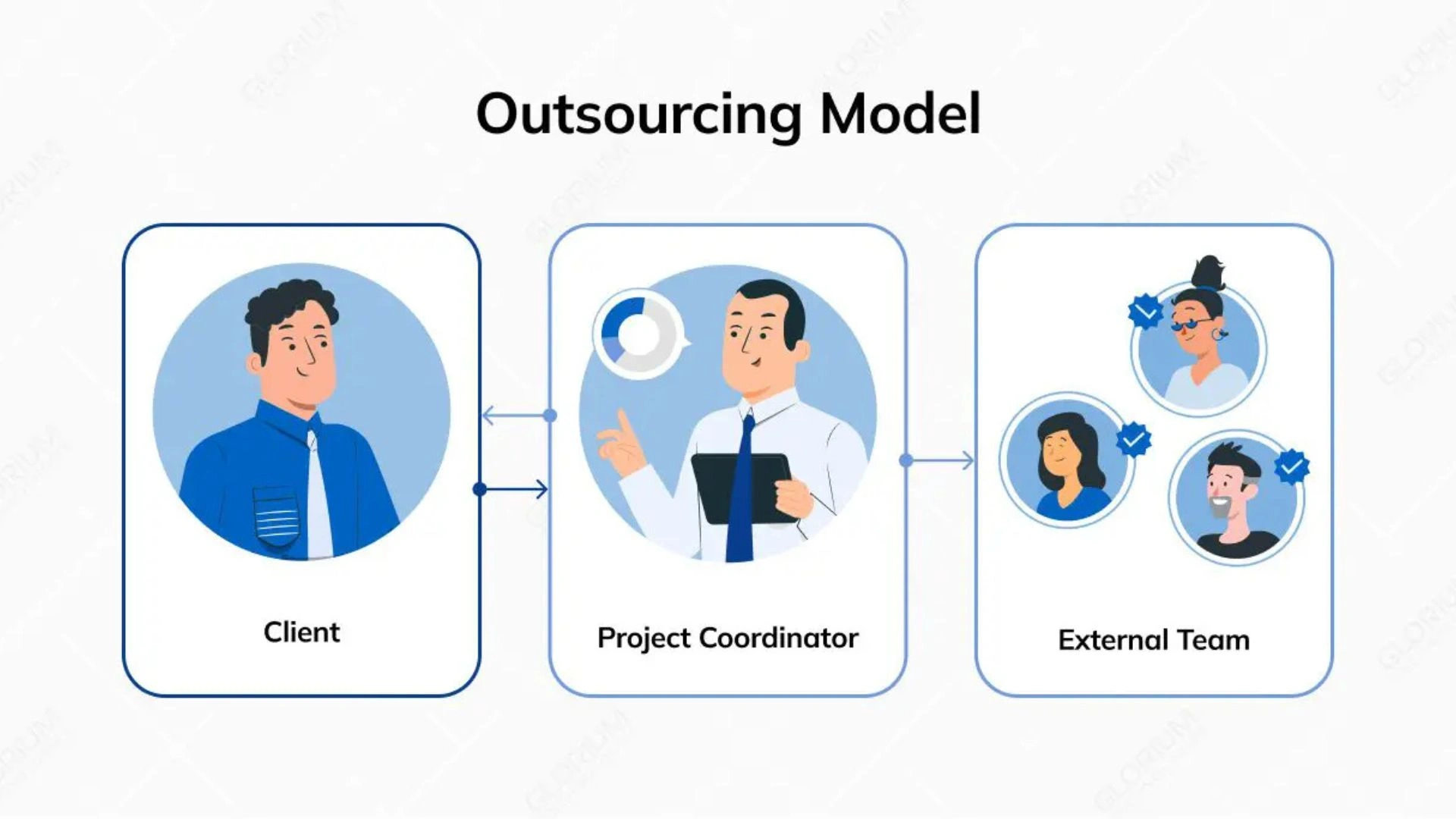
Staff outsourcing is a mode of hiring wherein a firm hires another entity to provide it with employees who work for it but under the payroll of the other entity. It could be used for various functions, such as customer service, IT, HR, finance, and even project implementation teams.
Key features of staff outsourcing:
- The outsourcing company recruits, selects, and hires the employees.
- The company’s customer drives daily activities and results.
- Contracts can be project‑based, seasonal, or long-term, allowing workforce flexibility.
This is in contrast to traditional recruitment, where employees are hired outright and then fully managed in-house for the long term.
The Global Rise of Outsourcing
The scale of outsourcing growth shows why so many businesses have embraced the model of staff outsourcing.
- The market for outsourcing services is likely to reach a magnitude of 866.96 billion USD in 2027, with a CAGR of 5.54% from 2020.
- On its own, the prediction for revenue generated by the IT outsourcing industry for the year 2024 is about 541.1 billion USD. Over 94% of companies use some form of IT outsourcing.
- Recruitment Process Outsourcing- Recruitment process outsourcing is also on an increasing trend, estimated at 10.3 billion USD in 2024 and set to rise to 25.8 billion USD by 2034 at a CAGR of 9.9%.
These statistics clearly indicate that outsourcing has not confined itself to back-office work but has been extended to strategic, project, and end-to-end HR and recruitment-related work.
Why Companies are Shifting
There are a number of powerful forces pushing the organisation towards the outsourcing of staff as opposed to going for internal recruitment.
1. Cost savings and efficiency
Cost savings are yet another major benefit that avails one to outsource.
- Through outsourcing, a company can gain between 15% and 30% of cost savings of operational costs, basically through personnel costs, office space, and training.
- An estimated 59% of the outsourcing community does it with the intention of cutting costs, which they use to fund more essential domains like the development of products or marketing.
Through outsourcing, the firm can convert fixed personnel costs to more variable costs that are easier to control.
2. Specialized talent utilisation
Talent shortages and skills gaps are increasingly driving firms to utilise outsourcing partners for niche or high‑demand roles.
- In one survey, 52% of the organisations responding cited access to people with specific skills as the most important reason for their outsourcing decisions.
- Outsourcing and staffing agencies do have extensive candidate networks. Moreover, they use advanced tools, like AI‑driven screening, to match specialised profiles in an amazingly short time.
This enables companies to acquire essential skills that may be hard to acquire or take time to recruit from the local marketplace.
3. Flexibility and scalability of the workforce
Staff outsourcing enables organisations to easily increase or reduce their workforce based on their needs.
- It enables seasonal or project-based capacity ramp-up without commitment to headcounts for extended periods of time.
- Increasingly, there are hybrid models of both in-house and outsourced workers. One can balance between core employees and flexible teams outside the company.
This flexibility makes it very valuable in industries where the workloads fluctuate, like e‑commerce, manufacturing, and healthcare.
Step-by-Step: How a staff outsourcing model works
Typically, companies tend to follow a definite procedure in transitioning from conventional recruitment to outsourcing staff.
Step 1: Evaluate Needs of Workforce
- Determine the roles that are time-consuming to fill, hard to retain, or are not central to your strategic agenda.
- Current costs per hire and costs associated with turnover can also be analysed.
Step 2: Choose the right outsourcing partner
- Short-list providers with experience in your industry, expertise in compliance, and good sourcing skills.
- Service levels, hiring process, background verification, and use of technological platforms (ATS, HRIS, and others).
Step 3: Define scope and engagement model
- Agree on the number of employees, locations, working hours and performance targets.
- Determine the type of model: full staff outsourcing, project-based teams, temporary employment, or temp-to-perm conversions.
Step 4: Onboarding & Integration
- The outsourcing partner hires and manages workers, and you manage the requisite training and ongoing operations.
- Ensure that your communication channels, reporting lines, and key performance indicators are aligned to allow outsourced employees to work seamlessly alongside your internal employees.
Step 5: Monitor Performance and Optimise
- Use metrics like cost per resource, productivity, quality scores, and retention rates.
- Regular reviews with the provider can be used to fine-tune estimates for headcount, skills, and processes.
Future Outlook for Staff Outsourcing
The trend that appears to emerge for the coming decade is that of greater reliance on staff outsourcing.
- The world market for outsourcing is predicted to grow to approximately 731.12 billion USD by 2034 at a CAGR of about 5.48%, including continued growth into new areas of back office work.
- With the trend towards working from home and hybrid working arrangements growing, worldwide payroll and HR outsourcing is increasing, with one study reporting that 45% of companies with remote workers outsourced their payroll operations in 2023.
Given the fact that over half of the companies are looking to outsource at least one business process, employee outsourcing is likely to continue being a cornerstone of the future workforce strategy.
FAQs
1. Is staff outsourcing applicable for large organisations alone?
No. Evidence shows that both large corporations and small businesses engage heavily with the concept of outsourcing, such that as high as 90% of the small businesses surveyed used some sort of outsourced support. The reason that small organisations usually outsource their staff is to gain access to high-quality human resources that they cannot afford.
2. What functions are most likely outsourced?
The key areas that are often outsourced are information technology, consumer support services, HR, payroll processing, and accounting. Nowadays, businesses are finding many specialised professionals, such as security experts, engineers, and data analysts, harder to directly employ for their businesses.
3. Does staff outsourcing impact quality and control?
Properly managed, outsourcing employees can help improve, if not preserve, service quality. This is because with clear key performance indicators and effective management, corporations can still maintain control over business operations, but with more expertise and systematic processes.
4. When can firms expect to realise the gains of employee outsourcing?
Visible benefits regarding cost savings and increased efficiencies may take the first 6 to 12 months, especially for high-volume or high-turnover positions. Other benefits, such as greater skill availability or quicker hiring, will likely emerge sooner, within the early phases of ramp-up.
Also Read:
Top Industries That Benefit Most from Staff Outsourcing
Top Qualities to Look for in a Recruitment Partner